

Ask whether a company is "on S/4HANA" and you will usually get a yes or a no. After reading the evidence company by company, I think most of those answers are wrong, because most companies in the German-speaking market are somewhere in between.
We have built a map of where SAP's in-house customers in Germany, Austria and Switzerland actually are, from what they and the people around them have put on the record, with a date on it.
Where companies stand
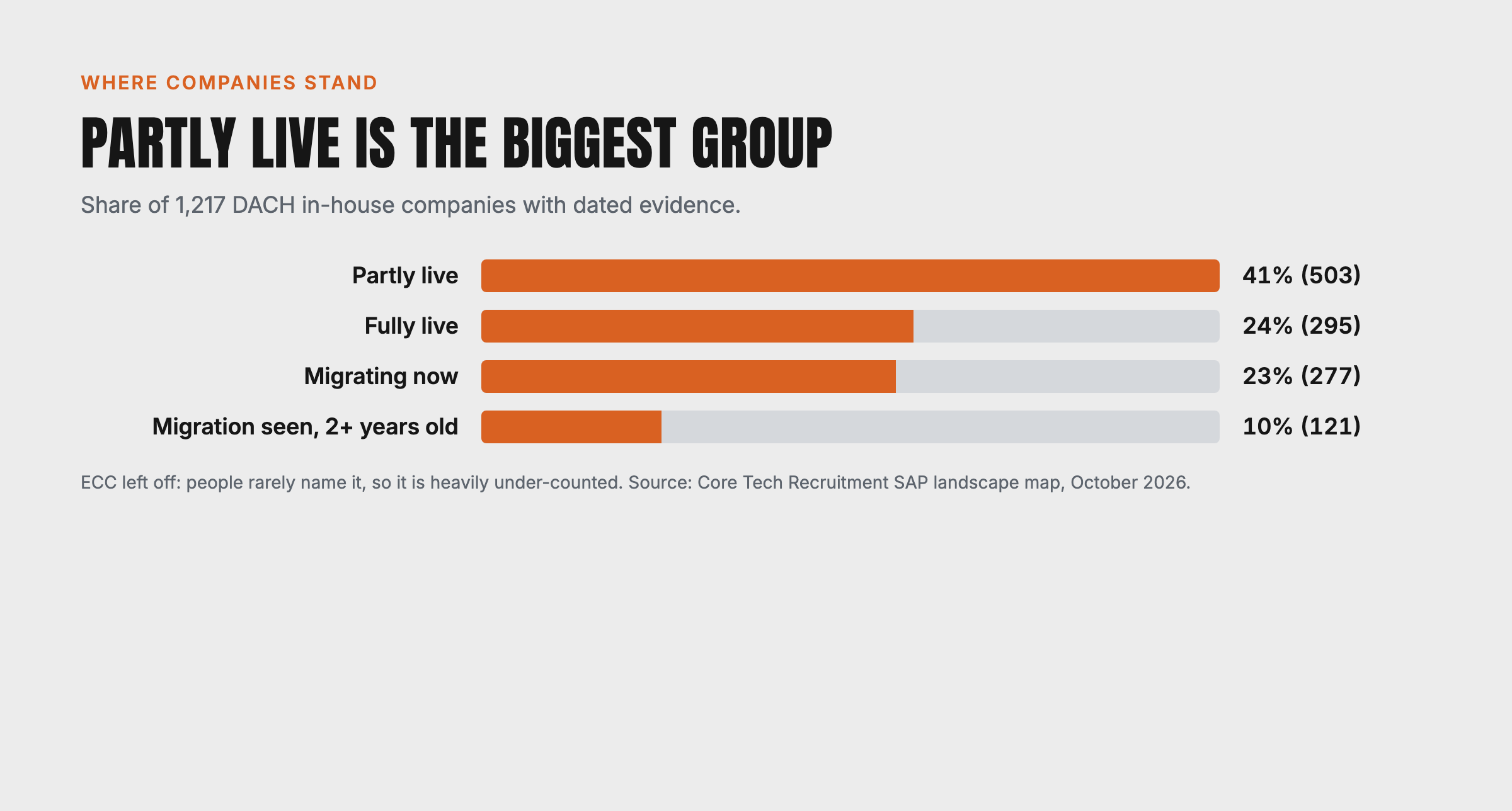
41 percent of the companies we could date are partly live on S/4HANA: one area, entity, country or plant has moved and the rest is waiting.
The full picture, across 1,217 companies with dated evidence:
- Partly live: 503 companies, 41 percent
- Fully live: 295 companies, 24 percent
- Migration under way now: 277 companies, 23 percent
- Migration seen, nothing newer for two years: 121 companies, 10 percent
- On ECC, no move seen: 21 companies, 2 percent
Do not read that last line as "only 2 percent are left on ECC". Hardly anyone writes ECC on a profile or in an advert, so a company still on it mostly shows up as silence. It is the least reliable number on this page, and I would not quote it.
The useful number is the first one. With mainstream maintenance for ECC ending in 2027, the biggest group is not waiting to start or celebrating the finish. It is halfway across, running two worlds at once.
The Mittelstand is behind the big groups
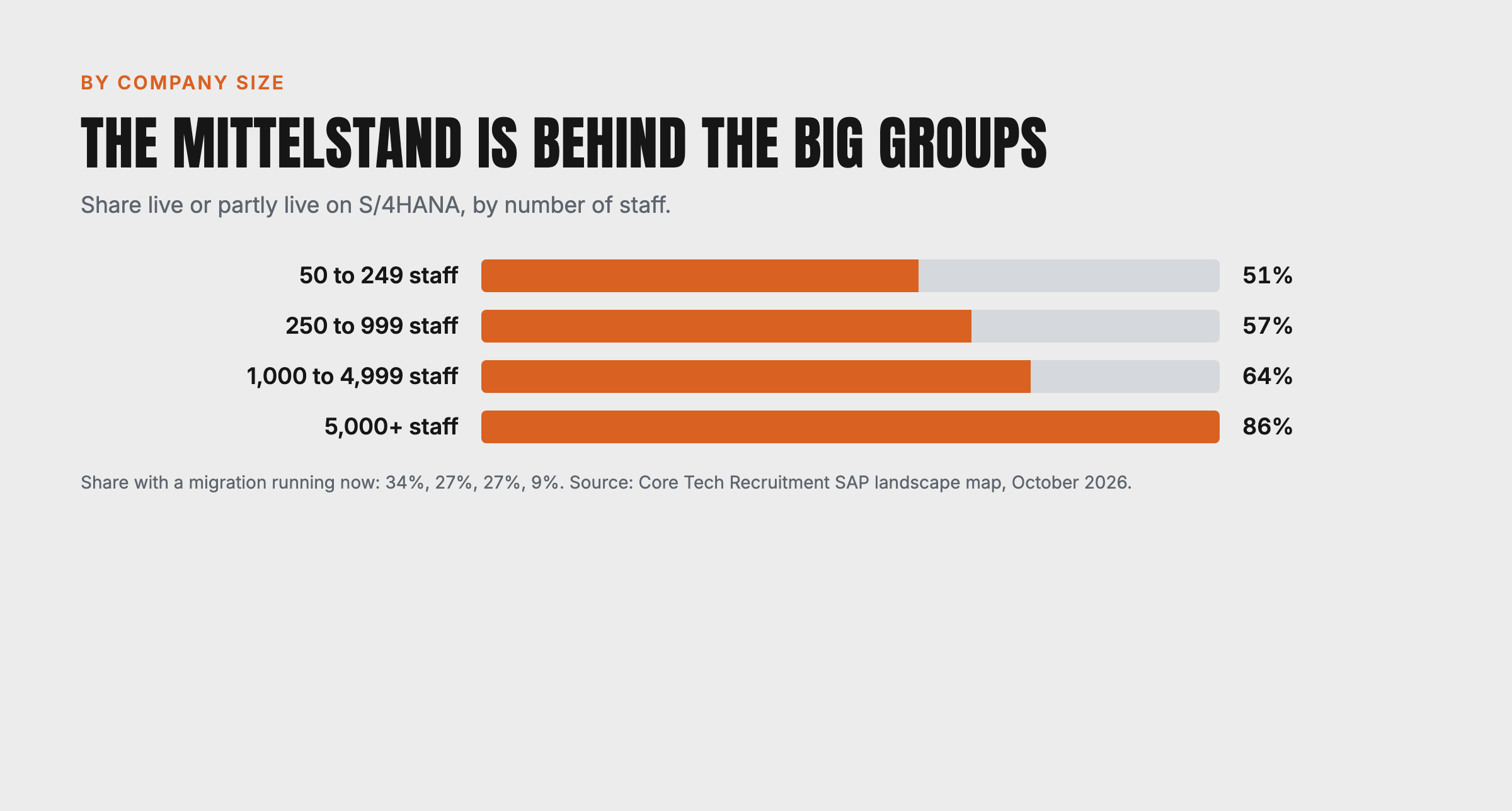
Size is the clearest dividing line in the data. Live or partly live on S/4HANA:
- 5,000 or more staff: 86 percent
- 1,000 to 4,999: 64 percent
- 250 to 999: 57 percent
- 50 to 249: 51 percent
The other side of that is where the work is now. Only 9 percent of the largest group have a migration running, against 27 percent in the two middle bands and 34 percent of companies with 50 to 249 staff. The large groups have mostly moved their core. The smaller companies are in the middle of it, usually with far fewer SAP people to do it with.
By sector, wholesale stands out: 39 percent mid-migration, the highest of any sector with 40 or more companies in the data. Electrical manufacturing and chemicals are furthest along, at 78 and 77 percent live or partly live.
Greenfield or brownfield: close to a coin toss
Where a company has stated its approach (260 of them), 47 percent went greenfield, 45 percent brownfield and 8 percent chose a selective data transition. Anyone telling you the market has settled on one route is selling that route.
The go-live curve
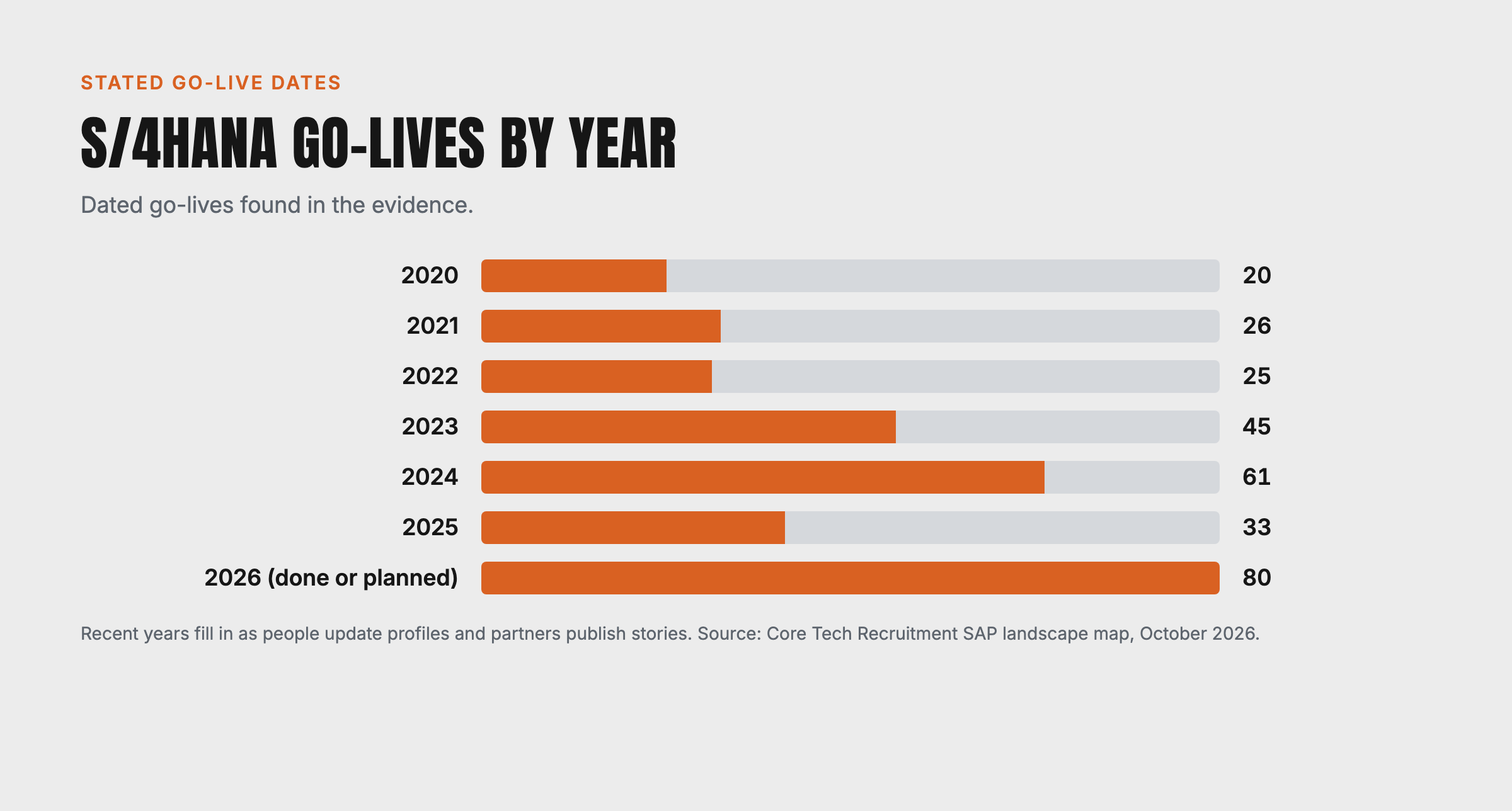
Stated S/4HANA go-lives by year: 25 in 2022, 45 in 2023, 61 in 2024, 33 in 2025 and 80 in 2026, completed or planned.
Two cautions. The 2026 figure mixes done and planned. And I would not read the 2025 dip as a real slowdown, because recent years fill in as people update their profiles and partners publish their stories. The direction since 2022 is the point, not any single bar.
What runs alongside the core
S/4HANA rarely moves alone, and the tracks around it are where a lot of the hiring sits. Counting companies with any evidence of each:
- EWM: 216 companies, the most common track alongside the core.
- SuccessFactors: 200 companies, against 66 where on-premise HCM is what we can see.
- BW and BW/4HANA: 109 companies, with Datasphere at 27. Plenty of reporting estates have not gone anywhere yet.
- BTP: 54 companies. Lower than the conference agenda would suggest.
These are counts of evidence, not market shares. They show what is visible, and they say nothing about what is running quietly in the background.
The pattern in the partly live group
The same few shapes came up again and again in the partly live group. Finance goes first and logistics follows later. HR runs on its own track to SuccessFactors. One pilot plant or country goes live on a global template, then the rollout waves start.
That matters for anyone hiring or moving. A company that is "live" in a press release can have years of rollout ahead of it, and those waves need people who have done the second and third site, not just the first. It also changes how to read a job advert: the phase a company is in tells you more about the role than the title does.
What this data cannot tell you
This is not a census, and I would be wary of anyone who says theirs is. Our sample is companies with a visible SAP workforce, which leans towards firms actively investing in SAP. The quiet ones are under-represented. Status comes from the newest evidence we could find, and evidence goes out of date. When we tested this against companies that have publicly announced their status, the other sources reached the same answer about seven times in ten. That is good enough to be useful and not good enough to bet a sales forecast on any single row.
We also looked at the split between RISE, public cloud and on-premise, and I have left it out. Too few companies state it clearly, so any percentage would be false precision.
How it was built
We screened 103,498 SAP professionals' public career profiles (more than 770,000 role and education entries), 9,167 SAP job adverts, 2,746 customer stories published by 13 SAP partners, SAP and trade news, and anonymised, aggregated insight from about 1,500 CVs in our recruiting work. That came down to 7,158 dated, quoted statements about companies' own systems, across 3,135 in-house companies. A company's status comes from its newest evidence, by area or site where the evidence says so. No individual is identified in the results.
Press and full list
Breakdowns by company size and industry, and a list of 276 named companies with status, areas, approach and go-live years, are available on request.
Carl Weaver, owner of Core Tech Recruitment, an SAP recruitment consultancy working across Germany, Austria and Switzerland: carl.ct@core-tech-recruitment.com, +49 211 90760099.
SAP-Personalberatung zu diesem Thema